
The Permit That Vanished: Inside the Two-Week Life and Sudden Death of Amazon's King George Water Permit
Amazon withdrew its 6.4-million-gallon aquifer permit for a King George County data center on day fourteen of a thirty-day public comment period. The questions it left behind are the story.
Update, September 9, 2026: Since publication, The Sankofa Question has received two further responses: an email from DEQ Director Michael Rolband confirming the withdrawn application "was for potable water for employee use (drinking water, toilets, kitchens, etc.) and not for cooling water as you stated," and a referral from Rep. Eugene Vindman's office to the congressman's communications staff. The article below has been revised to reflect the Director's confirmation; the original framing of this dispute has been corrected accordingly. A records request for the draft permit package remains pending with DEQ.
This article is part of an ongoing preliminary investigation by The Sankofa Question Magazine. Reporting is based on primary agency documents, public records, and source materials as described herein; findings are provisional and will be updated as further documentation is obtained. This edition incorporates corrections dated September 9, 2026.
A groundwater withdrawal permit for an Amazon data center campus in King George County, Virginia — contested by the county's own water utility, opposed by a sitting state senator, and publicly challenged on technical grounds by a county resident's six-document accountability campaign — is dead. Amazon Data Services, Inc. withdrew it on day fourteen of a public comment window scheduled to run thirty days.
The permit, numbered GWI000502, would have authorized Amazon to withdraw up to 6.4 million gallons of water annually from the Potomac aquifer beneath the Birchwood Tech Campus at 10900 Birchwood Drive. Its two-week public life — noticed August 12, withdrawn August 26 — compressed a fight that speaks to a question much bigger than one rural county: who gets to know what about the water beneath their homes, and when?
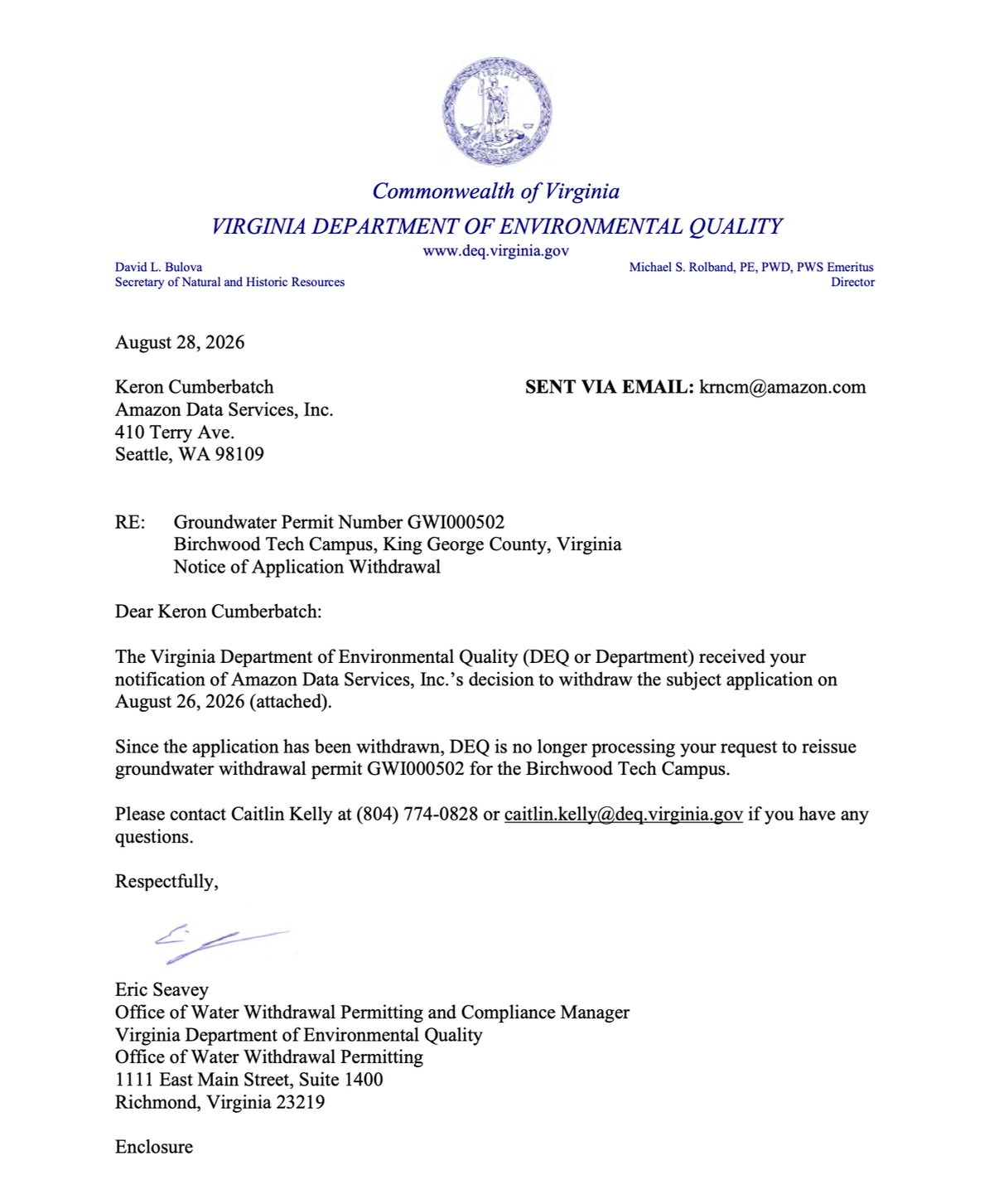
What follows is drawn from primary documents: a DEQ withdrawal letter signed by the agency's Office of Water Withdrawal Permitting and Compliance Manager; Amazon's own withdrawal notification to three DEQ officials; DEQ's public notices; a direct email response from DEQ's Director; responses from two congressional offices; and contemporaneous reporting from the Richmond Times-Dispatch and Daily Progress.
The Timeline
On August 12, 2026, the Virginia Department of Environmental Quality (DEQ) published a public notice of the draft permit — a reissuance application from Amazon Data Services, Inc. (AWS). The public comment window ran through September 11, 2026.
Opposition formed quickly. According to reporting by Dave Ress of the Richmond Times-Dispatch, relayed by the Daily Progress, the county's water utility opposed the permit, as did the state senator representing the area — because groundwater in nearby areas of the Potomac aquifer was already severely depleted.
The context for that opposition: ten days before Amazon's notice published, DEQ had rejected the county's own request to draw 3.25 million more gallons annually from the same aquifer — water intended for new housing and a hoped-for medical facility at Fairview Beach/Potomac Landing. The county water authority, meanwhile, is under state orders to cut 33.6 million gallons per year from its largest well to slow aquifer depletion, with replacement infrastructure estimated at $75–100 million. The reporting quotes the objection nearly verbatim: the department that issued the cutback directive "now proposes to hand a fresh allocation of 6.4 million gallons per year from the same aquifer in the same county to one of the largest corporations on Earth."
On August 26, 2026, at 1:29 PM, Keron Cumberbatch of Amazon Data Services emailed Caitlin Kelly, Eric Seavey, and Bryant Thomas of DEQ with official written notification of AWS's decision to withdraw the GWI000502 renewal application:
"AWS is aware of the public concerns raised regarding this permit. We take concerns of the community seriously, and after careful consideration, have decided to withdraw the application."
On August 28, DEQ's Eric Seavey confirmed in writing that the application was withdrawn and no longer being processed. Through September 11 — the window's stated end — the public comment period never closed. The applicant had ended the process fourteen days in. The public never received its full opportunity to comment on the draft permit.
What Was the Water For? A Correction in the Record
This publication's founding technical assessments — authored by publisher Ferron Broomfield, a King George County resident, investigative journalist, and veteran Aegis Computer Network Technician with over 15 years of hands-on experience with multiple cooling systems, including open- and closed-loop water cooling, aboard three U.S. Navy Aegis destroyers — initially argued the permit's volume reflected a legacy cooling technology choice: evaporative cooling towers consuming roughly 2 to 5 million gallons per megawatt-year, implying an IT load of roughly 1.3 to 3.2 MW. That hypothesis has since been contradicted by the primary record.
Amazon's withdrawal letter states the application "would have authorized AWS to withdraw up to 6.4 million gallons per year to provide water for potable and non-industrial purposes, exclusive of data center cooling operations." And on September 8, 2026, this publication received a direct email response from DEQ Director Michael S. Rolband — the same official to whom the founding technical assessments were addressed — confirming the agency's position:
"this application was for potable water for employee use (drinking water, toilets, kitchens, etc.) and not for cooling water as you stated."
Two primary sources — the applicant and the permitting agency's Director — now describe the application as potable-water-only: drinking water, toilets, kitchens. The founding assessments' cooling-water attribution was, on the record now in hand, incorrect as applied to this application. This publication reports that correction plainly. The arbiter of any residual ambiguity — including whether the previous permit term, which this renewal would have replaced, covered cooling or industrial uses — remains the draft permit package, formally requested from DEQ on September 8 under the Virginia Freedom of Information Act. When the response arrives, it will be reported in full.
What survives the correction, and matters prospectively: the technology precedents themselves. Microsoft's December 2024 announcement that its next-generation datacenter design consumes zero water for cooling; Novva Data Centers' 36 MW water-free facility; and a live precedent from northeastern Pennsylvania, where a developer publicly committed not to use well water for cooling under resident pressure, per Fortune's May 2026 reporting. Whether or not GWI000502 ever covered cooling, AWS has stated its intent to work with DEQ "to identify alternative sources for potable water service to the future campus" — and the aquifer math documented here applies to whatever is eventually built at Birchwood Drive, whatever it consumes water for.
A Preview of Trajectories: What Comparable Communities Have Documented
Because the permit died before impacts could materialize, the closest evidence for what could have happened comes from communities that lived it. This is extrapolation from documented outcomes elsewhere, not evidence about King George; it is labeled as such.
In Loudoun County, Virginia — the world's densest data center corridor — drinking-water use served by the local utility rose more than 250 percent between 2019 and 2023 as data centers scaled, with data centers consuming roughly 899 million gallons countywide in 2023, and their share of Washington-metro water consumption projected to climb from 8 percent in 2025 to 25 percent by 2035. The tax windfall — roughly $1.3 billion projected, some 40 percent of county revenue — arrived bundled with the water dependency, and with resident backlash. Loudoun is not King George's demographic twin; it is the destination, not the analog.
In Newton County, Georgia, a Meta data center reportedly disrupted nearby private wells — families hauling water, replacing sediment-clogged appliances. In Coweta County, Georgia, residents appealing a hyperscale campus catalogued the candidate impacts on rural, well-dependent terrain: declining property values, well damage from construction vibration, light pollution erasing rural night skies, and the constant hum of diesel backup generators. In Ohio, the state Farm Bureau advised residents near proposed data centers to establish baseline well-water testing every two to six months — "in case something ever does happen."
For King George, the extrapolations are candidates, not conclusions. None is evidenced in King George today. All are documented somewhere else.
The Setting: A Company Town Whose Company Is the Navy
King George County — roughly 27,900 residents and 10,100 households, median household income about $116,900 per the most recent U.S. Census estimates (ACS 2020–2024) — is not the profile its rural geography might suggest. About one in five residents is a child under 15, per Census age-distribution data, and the county's economy is inseparable from Naval Support Facility Dahlgren: 4,300 acres on the Potomac, roughly 11,000 total personnel as of fiscal 2019, federal civilian salaries exceeding $627 million in fiscal 2020, and roughly a third of the base's workforce residing in the county, per NSA South Potomac economic impact reports.
Against that backdrop, the county's residents hold both the standing and the technical literacy to scrutinize an aquifer permit. These are engineers and defense professionals; a community that can check the math.
The Delegation Responds — Sort Of
Outreach to Virginia's congressional delegation, the King George County Board of Supervisors, DEQ leadership, and the Governor's Office drew three documented replies — two referrals and a correction.
An email response from Senator Tim Kaine's office, dated September 2, 2026, and signed by the senator, acknowledges receipt of the submission and notes that groundwater permitting "is not a federal matter – rather, it is one addressed at the state level." The email directs further inquiry to the Virginia General Assembly and the Office of Governor Abigail Spanberger, and points to the senator's website for updates. It offers no position on the underlying questions raised in the submission.
A second response arrived September 9 from the office of Representative Eugene Vindman (VA-07): legislative aide Amber Townes acknowledged the submission and referred the correspondent, with the office's contact information, to the congressman's communications director for "any questions or documents." No position on the underlying questions was offered; the substance of the referral is a contact handoff to media-relations staff.
The third response came from the top of the state agency itself: DEQ Director Rolband's September 8 email, quoted above, confirming the potable-water purpose and the withdrawal — and answering none of the five recommended permit conditions, the cumulative-impact questions, or the transparency gaps raised in the submission. The Director thanked the correspondent for the information and shared it with staff.
The federal tally stands: two offices contacted, two responses received, two referrals issued — one to the state government, one to the press office. In fairness, both responses are prompt, courteous, and procedurally rational: groundwater permitting is, as Senator Kaine's office noted, a state matter. The record nonetheless documents a pattern — every door in the building points to another door, and the office with authority over the withdrawn permit has answered with a correction and a thank-you.
What Comes Next
Four open questions, in order of consequence:
1. What did the draft permit actually say? The potable-water characterization is now twice-confirmed in writing, but the draft permit package remains the dispositive record — and may reveal what the previous permit term covered. A formal records request filed with DEQ on September 8, 2026, under the Virginia Freedom of Information Act, seeks the complete record.
2. Will AWS refile? The withdrawal is of an application, not a plan. AWS has stated intent to pursue "alternative sources for potable water service." Any refiled application should be watched for whether its permitted uses, volumes, or conditions differ — and whether the technology questions raised during this cycle are answered before authorization.
3. Why did DEQ's public systems lag the fact of withdrawal? A check of DEQ's Permit Transparency Portal on August 29 — three days after Amazon's withdrawal notification — still returned the permit in "applicant coordination phase." A resident checking the portal in that window would have seen an active permit the applicant had already abandoned.
4. What can residents do now? Per Ohio Farm Bureau guidance relayed in comparable cases: baseline well-water testing on a two-to-six-month cycle is the zero-cost insurance a county without a monitoring framework lacks.
The aquifer doesn't care whose narrative prevails. It responds to withdrawals, tracked or not. And the question King George residents are left holding — fourteen days into a comment period that ended without them — is now simpler and harder than the one that started this investigation: not whether the county could stop a permit, but whether the next one gets written with the county's questions answered first.
Ferron Broomfield is the publisher, editor, and writer of The Sankofa Question Magazine. The technical assessments referenced in this article were authored by him; the correction of their cooling-water characterization, and all responses quoted herein, are reported in full in the interest of that disclosure.
Keep This Work Going. Hit the subscribe button.
This investigation was built the slow way: original research, verified sources, every claim checked before it reached you. That work is funded by readers, not advertisers — which is exactly why it can ask hard questions.
The Investigator — $5/month or $50/year. Every weekly article, full newsletter access, the complete archive, and limited audio and video interviews.
The Collector — $9/month or $90/year. Everything above, plus full-length interviews, the complete archive, and the full magazine experience: downloadable EPUB and PDF editions with trivia, games, college references for every discipline covered, and original Sankofa Question Magazine artwork.
Evidence Before Assertion — Shaping Black Futures. Investigating The Past.
Not ready to subscribe? Get the next investigation first. Just Sign up now. One email when the first article of each issue publishes, and breaking investigations, its sources, and the Sankofa Question behind it, straight to your inbox. Free. No noise, no filler.